
Human-Robot Collaboration

In the future, collaborative robots and digital assistance systems are set to unburden human workers within an increasingly demanding and evolving work environment.

Collaboration between humans and machines is not a new concept: indeed, it is already being researched and implemented in practice across both industry and academia. In areas such as assembly, packaging, component placement and fastening - as well as in quality control - the boundaries between workstations are becoming increasingly blurred, with humans and robots working side by side more and more.

The institutes of the Fraunhofer Group for Production address key areas of expertise and research within the field of human-robot collaboration, placing a particular focus on the aspect of safety.
Safe Human-Robot Collaboration

Privacy warning

With the click on the play button an external video from www.youtube.com is loaded and started. Your data is possible transferred and stored to third party. Do not start the video if you disagree. Find more about the youtube privacy statement under the following link: https://policies.google.com/privacy

Fraunhofer IFF – Research Explained: Safe Human-Robot Collaboration

Latest Updates on Human-Robot Collaboration from Our Network Institutes

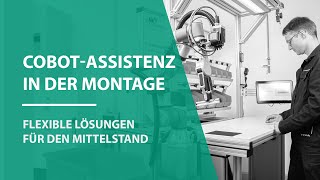
Cobot Assistance in Assembly

Privacy warning

With the click on the play button an external video from www.youtube.com is loaded and started. Your data is possible transferred and stored to third party. Do not start the video if you disagree. Find more about the youtube privacy statement under the following link: https://policies.google.com/privacy

In the industrial sector, heavy physical or monotonous tasks are increasingly being taken over by collaborative robots (cobots). At the Hannover Messe, we demonstrated how a cobot handles downstream work steps during assembly, thereby relieving the human worker.

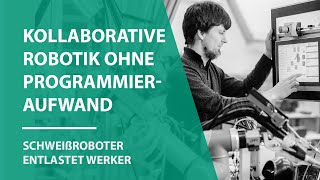
Collaborative Robotics Without Programming

Privacy warning

With the click on the play button an external video from www.youtube.com is loaded and started. Your data is possible transferred and stored to third party. Do not start the video if you disagree. Find more about the youtube privacy statement under the following link: https://policies.google.com/privacy

Welding tasks previously performed manually can be economically automated - even for small batch sizes - using sensor-guided collaborative robots (cobots). Programming skills on the part of the operator are not required.


Intuitive Assistive Robot for Processing Large Components (INTAS)

The goal is to develop an intuitive assistive robot that, thanks to its ease of use and programming, can perform a wide variety of tasks on large components.


MR_KOOP

The goal is to develop new tools and methods for the preliminary planning of industrial robot cells with specialized functions for safe human-robot collaboration. Thanks to sensor technology, these robots are able to perceive their surroundings and can respond to events much more flexibly than the first generation of industrial robots.  


MFlex 2025

The objective of this project is the development of reconfigurable and flexible automated systems for future aircraft production. The planned work encompasses the further development of modular, mobile, robot-based production systems -taking into account aviation-specific constraints such as rapid referencing and high precision - as well as the creation of the necessary IT solutions to flexibly integrate these modules into an overall system.


ColRobot (Collaborative Robotics For Assembly and Kitting in Smart Manufacturing)

The project combines state-of-the-art European robotic technology with the highest user requirements for assembly processes to develop a collaborative, mobile manipulator capable of performing repetitive, monotonous tasks and providing assistance.

Human-Robot Collaboration

In the context of digitalization and the need to safeguard competitiveness, there is a high demand for flexible automation solutions - particularly for repetitive and physically demanding handling tasks. However, due to increasing demands for flexibility in batch-size-one production, fully automated robotic systems cannot be deployed economically. Novel forms of human-robot collaboration (cobots) offer innovative solutions in this regard.


A Simple Introduction to Robot Automation

The "xito" platform - the result of the SeRoNet research project -brings together robotics providers and users, enabling them to jointly create solutions. On October 28 and 29, 2021 a public virtual conference will demonstrate how xito -thanks in part to IPA technologies -facilitates entry into robotic automation and can help small and medium-sized enterprises generate greater added value.


Multimodal Assembly Assistance

The project “Adaptive Assembly Assistance and Interaction System Using 3D Scene Analysis and Intuitive Human-Machine Communication,” or MonSiKo for short, focused on providing assembly support through modern sensor and communication technologies.


Gesture-based robot programming

Gesture-based programming relies on stereo vision. This involves the use of two 2-D cameras positioned in the room, which enable reliable detection of gestures and components.


Cobot is tightening screws

Automating assembly processes at BMW Motorrad poses a major challenge due to the highly dynamic environment. A project team from BMW Motorrad and Fraunhofer IPK has developed a prototype solution for automated screw fastening.


The New Ergonomics

Health issues resulting from poor posture in the workplace represent a major challenge of our time. PowerGrasp, a textile exosuit, prevents these issues through ergonomic support and force assistance.

Extended Reality Applications for the Industrialization of Production Lines

How can companies benefit from extended reality (XR) in manufacturing?


Compact safety zones for production without protective fencing

The method developed at Fraunhofer IWU makes it possible, for the first time, to efficiently and reliably calculate safety zones for robot-based systems - regardless of their kinematics. Based on actual motion paths and velocities - in contrast to the status quo - hazard zones are calculated only where hazards can actually arise.


Path Planning and Optimization for Robotic Systems

Robot-based systems are becoming increasingly complex and the number of integrated robots is also on the rise. A multitude of robots with overlapping workspaces inevitably results in a higher risk of collisions. The path planning framework developed at Fraunhofer IWU addresses these challenges by integrating state-of-the-art path planning algorithms.